
Do You Really Have to Arrive an Hour Before Sunset?
No — not if you plan backward from your deck arrival time. The "arrive 60–90 minutes early" advice you'll find in most English-language guides quietly bundles two different things together: the time you spend in lines, and the time you spend on the deck. Split them apart and the math changes.
Here's the claim this article makes, and then proves with timestamps: reaching the observation deck at sunset time is enough. You'll still see the city in daylight, watch the color fade through golden hour, and stay for the night view — because the sky doesn't switch off at sunset, and the deck doesn't empty out.
What you actually need to manage is not "how early do I start queuing" but "what time do I want to step onto the deck, and when do I need to be at the 4th-floor gates to make that happen." The rest of this guide gives you the numbers to do that calculation for any month of the year.
One honest caveat up front: this is one documented visit, on a relatively quiet August weekday (a Friday). Weekends, holidays, and peak seasons will be busier — treat my line timings as a lower bound, not a promise.
Proof: A Minute-by-Minute Timeline From August 9, 2024
Every time below comes from the EXIF timestamp of a photo I took that evening. Sunset in Tokyo that day was around 18:37.
-
At the base of the tower. Photo of the Skytree exterior from street level. No rush — the target was the deck, not the queue.
-
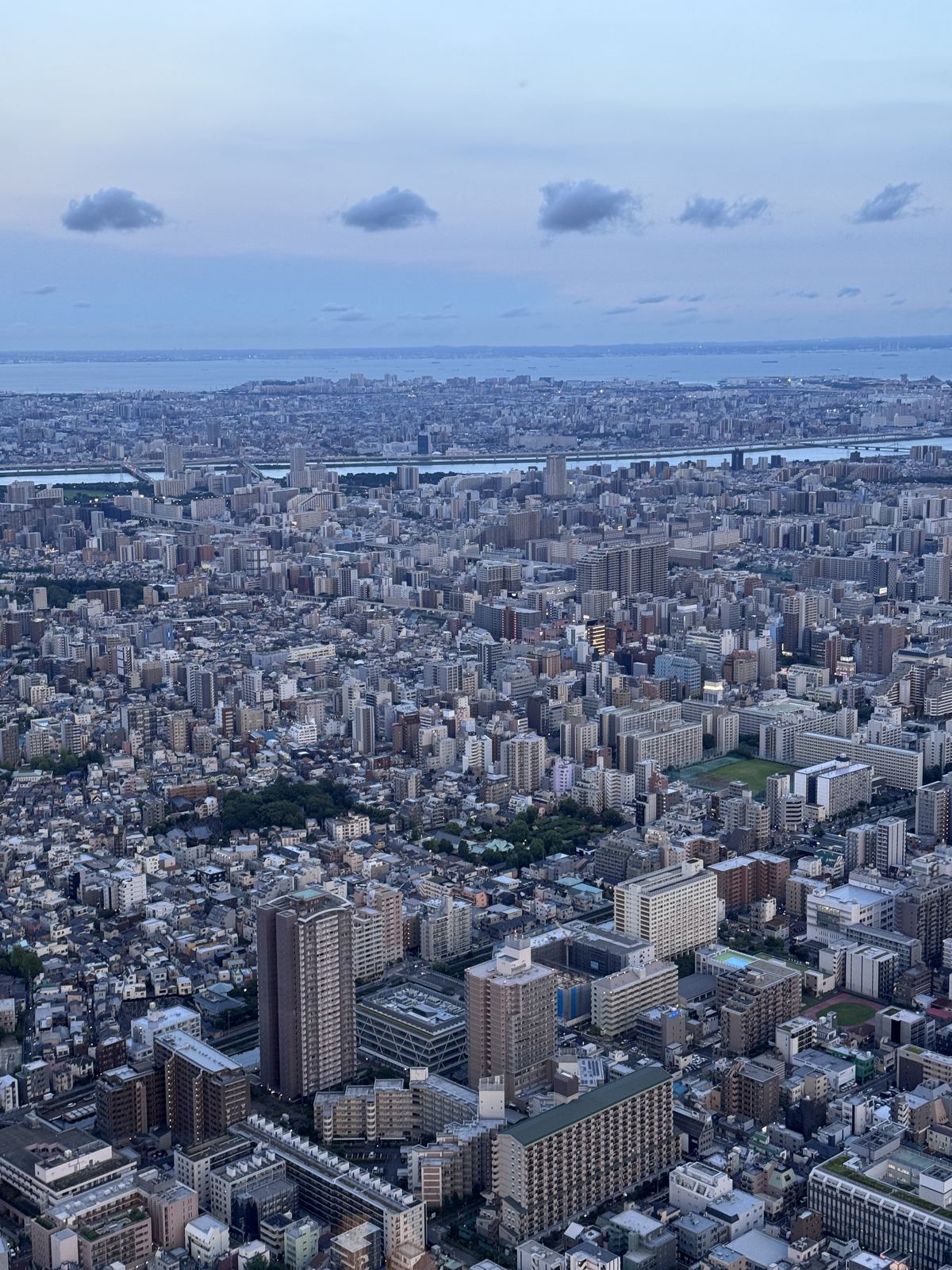
Stepped onto the Tembo Deck — 11 minutes before sunset. The city was still fully lit in late-afternoon sun.
-
Daylight views. Honestly: this phase lasted only about 10 minutes for me. If a long daytime panorama matters to you, arrive one slot earlier — but for the classic "day fading into night" arc, this was enough.
-
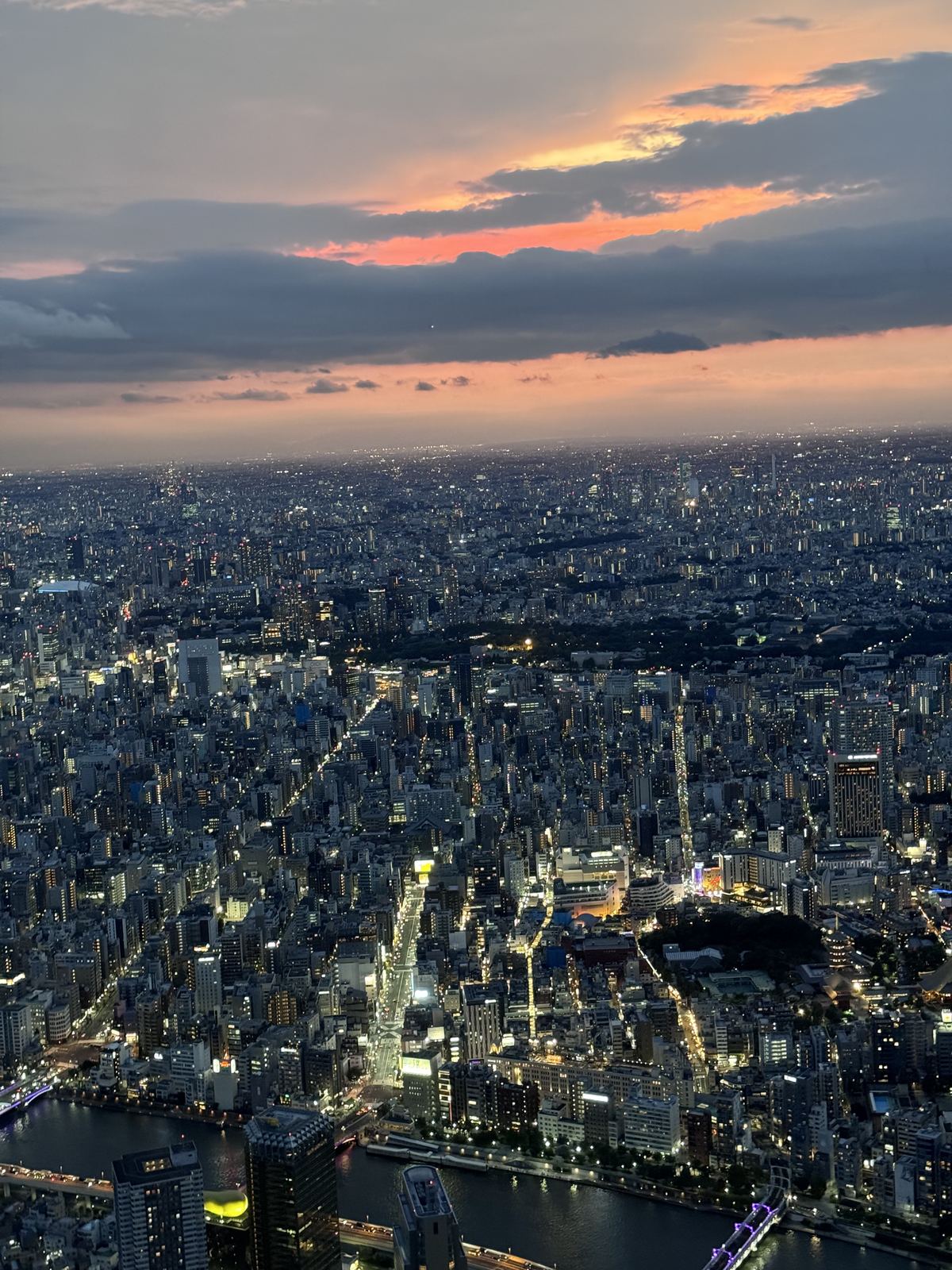
The gradient. Orange to pink to deep blue over roughly 20 minutes. This is the part everyone comes for, and it happens after sunset time, not before it.
-
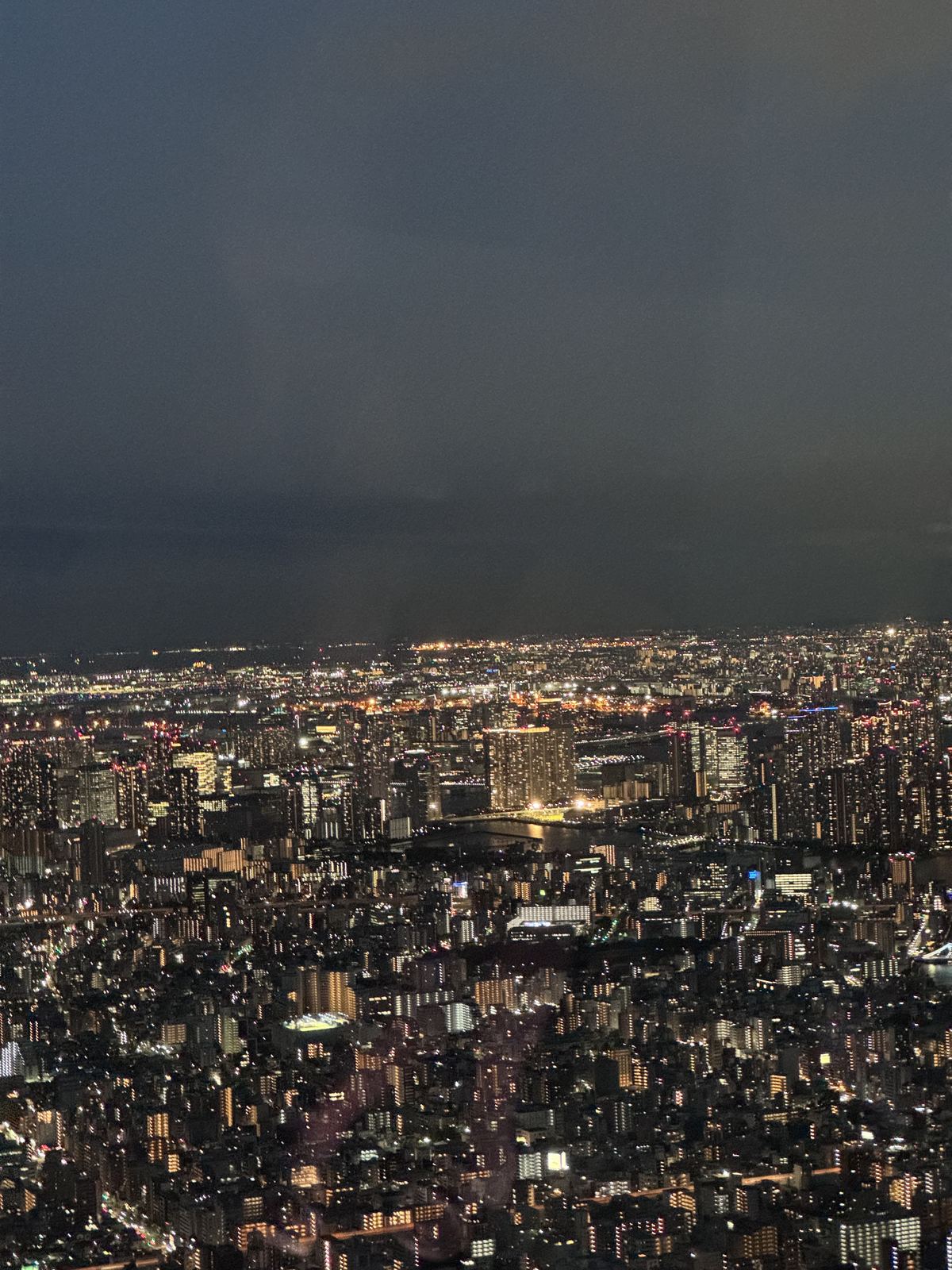
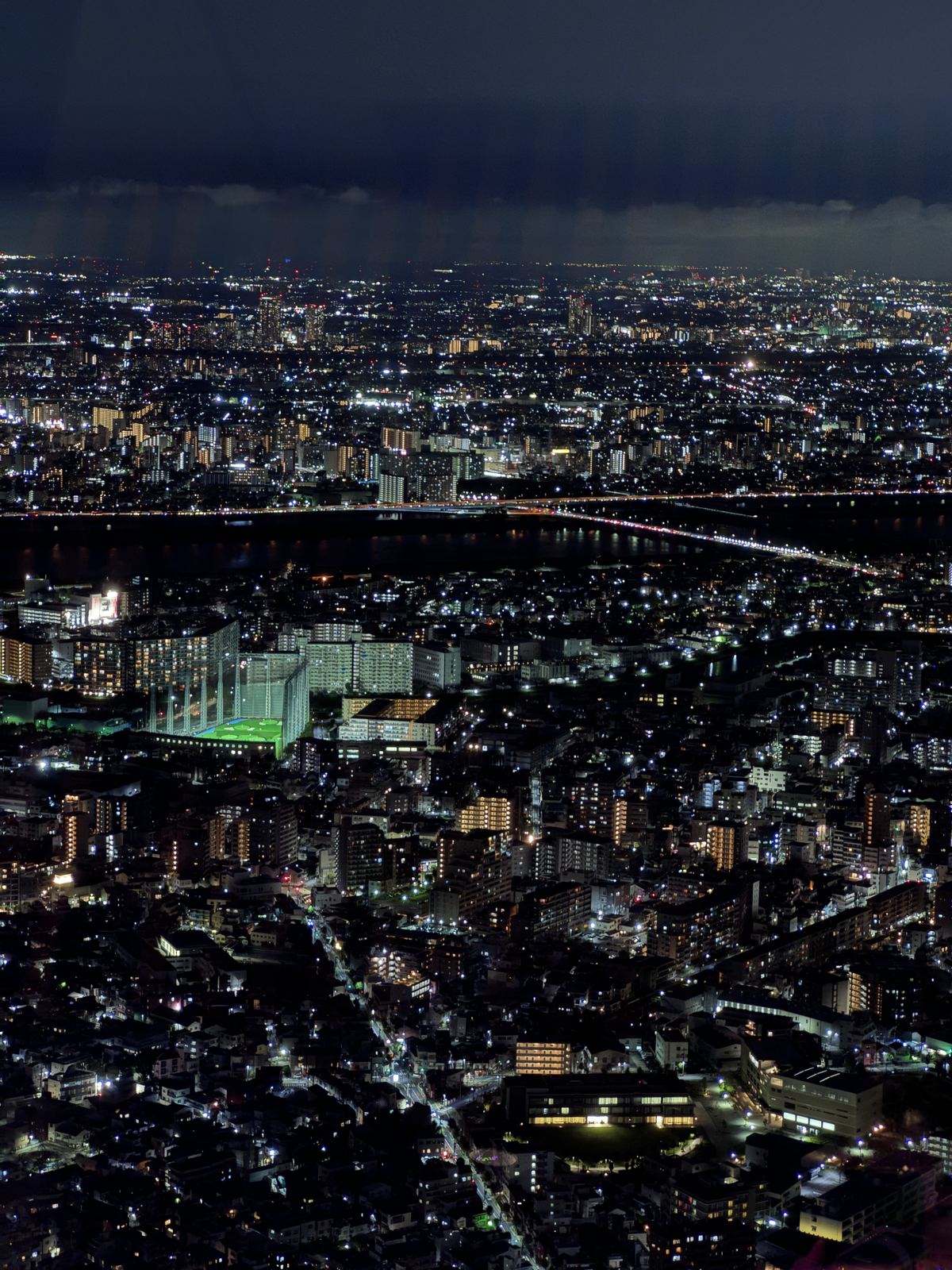
Night view. City lights fully on. I had a soft-serve ice cream from the deck café and kept circling the windows. No one was asking anyone to leave.
-
Sloped corridor and the tower's own light-up. By now the crowd had visibly thinned.
-
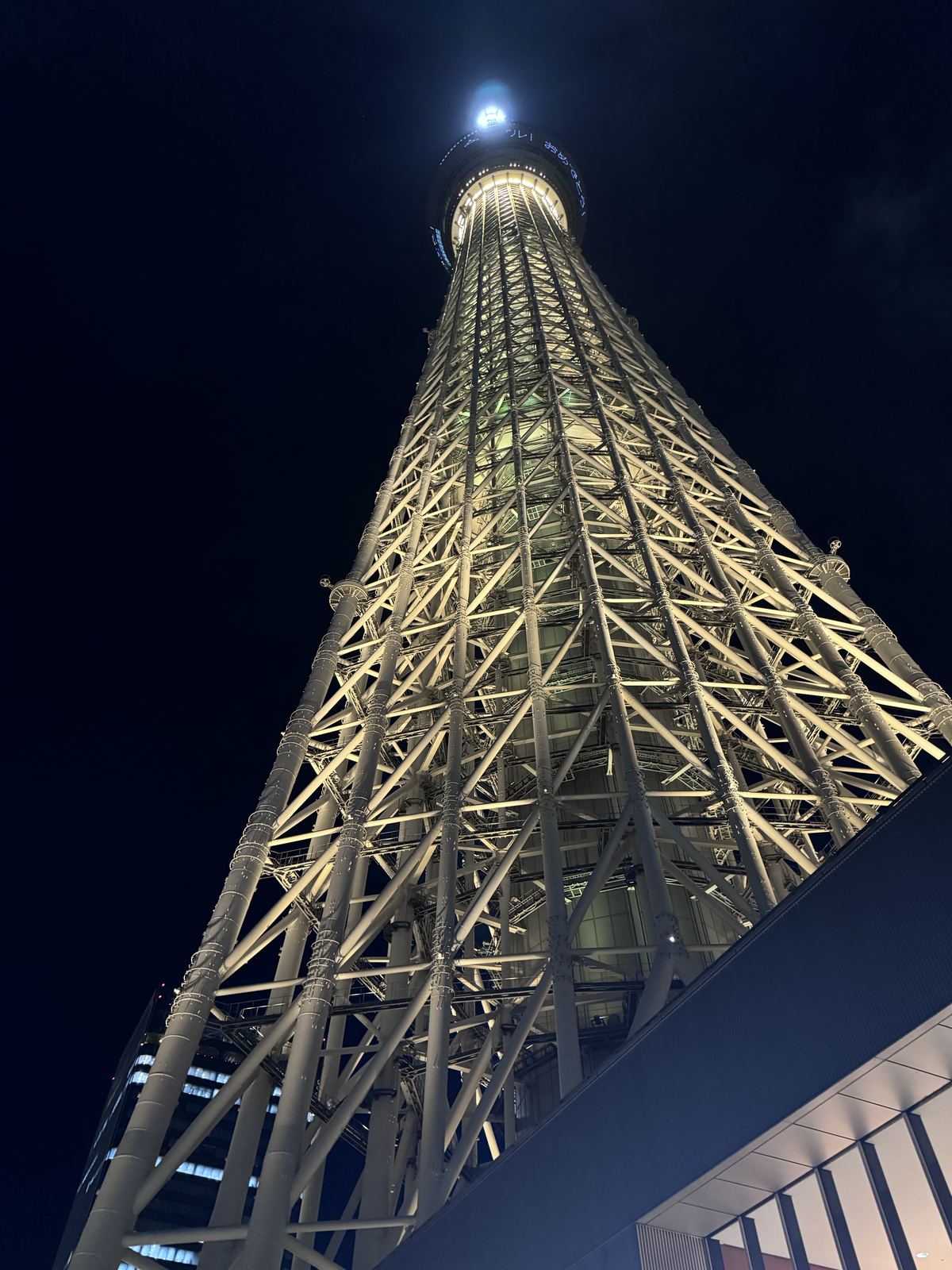
Back on the ground, looking up at the illuminated tower — the classic closing shot.
How Long Are the Lines at Tokyo Skytree?
Two different lines matter, and I can only vouch for one of them firsthand:
- Elevator / entry line: 5–10 minutes. I stood in this one. It moves steadily — the elevators are fast and large.
- Same-day ticket purchase line: looked like roughly 20–30 minutes. I did not stand in this line — this is an eyeball estimate from walking past it on the 4th floor. Treat it as a rough impression, not a measurement.
Remember the context: a comparatively quiet August weekday evening. On weekends, holidays, and clear-sky days after rain, both lines will be longer. Use these numbers as the floor, not the ceiling — and if you're visiting on a Saturday, add buffer generously.
Count Backward From Deck Arrival — Not Forward From the Queue
This is the whole trick. Instead of asking "how early should I line up?", decide what time you want to be standing at the window, then subtract the steps in front of it:
-
1
If you have an online timed ticket (recommended): be at the 4th-floor gates 30 minutes before sunset. That covers the 5–10 minute elevator line plus a buffer, and puts you on the deck a few minutes before the sun goes down. On weekends, add another 10–15 minutes.
-
2
If you're buying a same-day ticket: add the purchase line on top — the one that looked like 20–30 minutes on a quiet day — plus a ¥500-per-ticket counter surcharge. This is why I don't recommend the same-day route for a sunset visit: it reintroduces exactly the uncertainty you're trying to remove.
-
3
If you arrive early: don't stand in line — you've already got a timed ticket. Spend the spare time in Tokyo Solamachi, the shopping complex at the tower's base, and walk up to the gates at your calculated time.
What Time Does the Sun Set in Tokyo? (Month by Month)
To reuse the backward calculation in any season, you only need one input: sunset time on your date. Approximate mid-month values for Tokyo:
| Month | Sunset (approx.) | Month | Sunset (approx.) |
|---|---|---|---|
| January | 16:50 | July | 18:55 |
| February | 17:20 | August | 18:30 |
| March | 17:50 | September | 17:50 |
| April | 18:10 | October | 17:05 |
| May | 18:35 | November | 16:35 |
| June | 18:55 | December | 16:30 |
Mid-month values rounded to 5 minutes, based on National Astronomical Observatory of Japan ephemeris data for Tokyo. Sunset shifts by up to ~15 minutes within a month — look up the exact time for your date before booking your entry slot.
And here's why arriving at sunset still works: the sky stays bright for roughly 25–30 minutes after sunset (what astronomers call civil twilight), and the strongest colors often come 10–20 minutes after the sun goes down. On my August visit, the gradient ran until about 18:55 — 18 minutes past sunset. That's the physics behind this advice, and it holds in every month, not just summer.
Which Tokyo Skytree Ticket Should You Buy?
Three routes, in order of how strongly I'd recommend them for a sunset visit:
1. Official online timed ticket — the one to get
Buy on the official Tokyo Skytree site, choosing a date and entry slot. As of July 2026, adult (15+) prices start at ¥1,800 for the Tembo Deck (350 m) and ¥3,000 for the Combo ticket (Tembo Deck + Tembo Galleria at 450 m) — exact prices vary by date. Your ticket is a QR code you show at the gates, which is what makes the backward-planning approach reliable: no purchase line at all.
Is the Combo worth it for sunset? The classic sunset panorama is from the Tembo Deck; the Galleria's sloped corridor is a different experience (I walked it at 19:42, after dark, and enjoyed it). If budget is tight, the Deck alone delivers the view this article is about. If you can't decide on the day, a Galleria add-on can be bought at ticket machines on Floor 350 after you're up there.
2. Same-day ticket — works, but not for sunset
Same-day tickets exist at the 4th-floor counter and vending machines, with a ¥500-per-ticket service fee added — and, more importantly for this article, an unpredictable purchase line in front of them. Fine for a flexible daytime visit; a bad fit for hitting a 20-minute sunset window.
3. The splurge: Sky Restaurant 634
If you want the sunset with dinner instead of a crowd, the tower's Sky Restaurant 634 (on Tembo Deck Floor 345) is the indulgent route. What I could verify as of July 2026: check-in is at the restaurant's own counter at the West Entrance, 4th floor of Solamachi Tower Yard, 30 minutes before your reservation — a separate flow from the general queue. Dress code is smart casual (T-shirts, jeans, shorts, sportswear, and sandals are not permitted), and Skytree admission is charged in addition to your dinner. English-language reservations are available through byFood or TableCheck. I haven't verified current course prices or prepayment terms — check both when you book; expect a serious dinner bill.
The online ticket, the QR code at the gate, and the sunset lookup all assume one thing: your phone has data in Japan. Sort that out before your trip, not at the tower.
Compare eSIM vs Pocket Wi‑Fi for Japan →Getting There From Asakusa: One Stop on the Tobu Line
Most sunset visitors come from the Asakusa side, and the local move is simple: from Tobu Asakusa Station, it's one stop (about 2 minutes, ¥150) on the Tobu Skytree Line to Tokyo Skytree Station, which sits directly under the tower. You can also walk it — across the Sumida River and along the streets with the tower in view the whole way — in what took me a relaxed 15–20 minutes when I lived there.
Tokyo Metro's Hanzomon Line and the Toei Asakusa Line also stop at Oshiage Station on the tower's other side, if you're coming from elsewhere in the city.
Optional Detour From Asakusa: Dorayaki Before Skytree
If you're starting in Asakusa with time to spare, there's a short detour I'd mention to a friend — with honest expectations attached. Kameju, a decades-old confectionery next to Kaminarimon, sells what many Tokyoites consider the city's benchmark dorayaki: two small pancakes sandwiching sweet bean paste (the snack famously loved by the robot cat Doraemon).
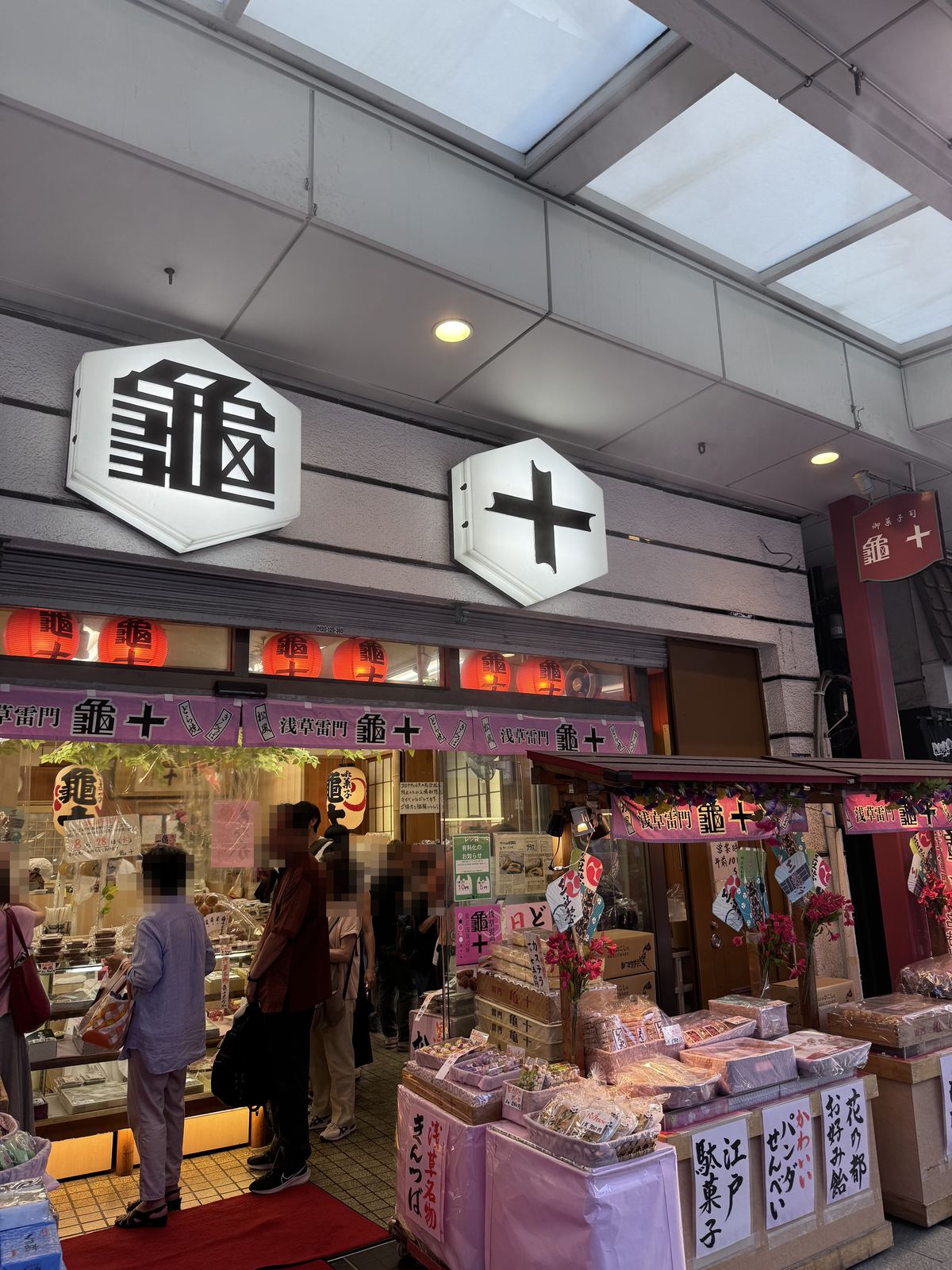
- What's actually special: the pancake itself — lightly caramelized, almost soufflé-soft. The pancake is the star here, not the filling.
- Honest note on the filling: if you've never had anko (sweet red bean paste), know that it's dense and sweet in a way that divides first-timers. Some travelers love it immediately; some don't. That's normal.
- The milder option: there's a white-bean (shiro-an) version — that's the one in my photo, and the gentler introduction of the two.
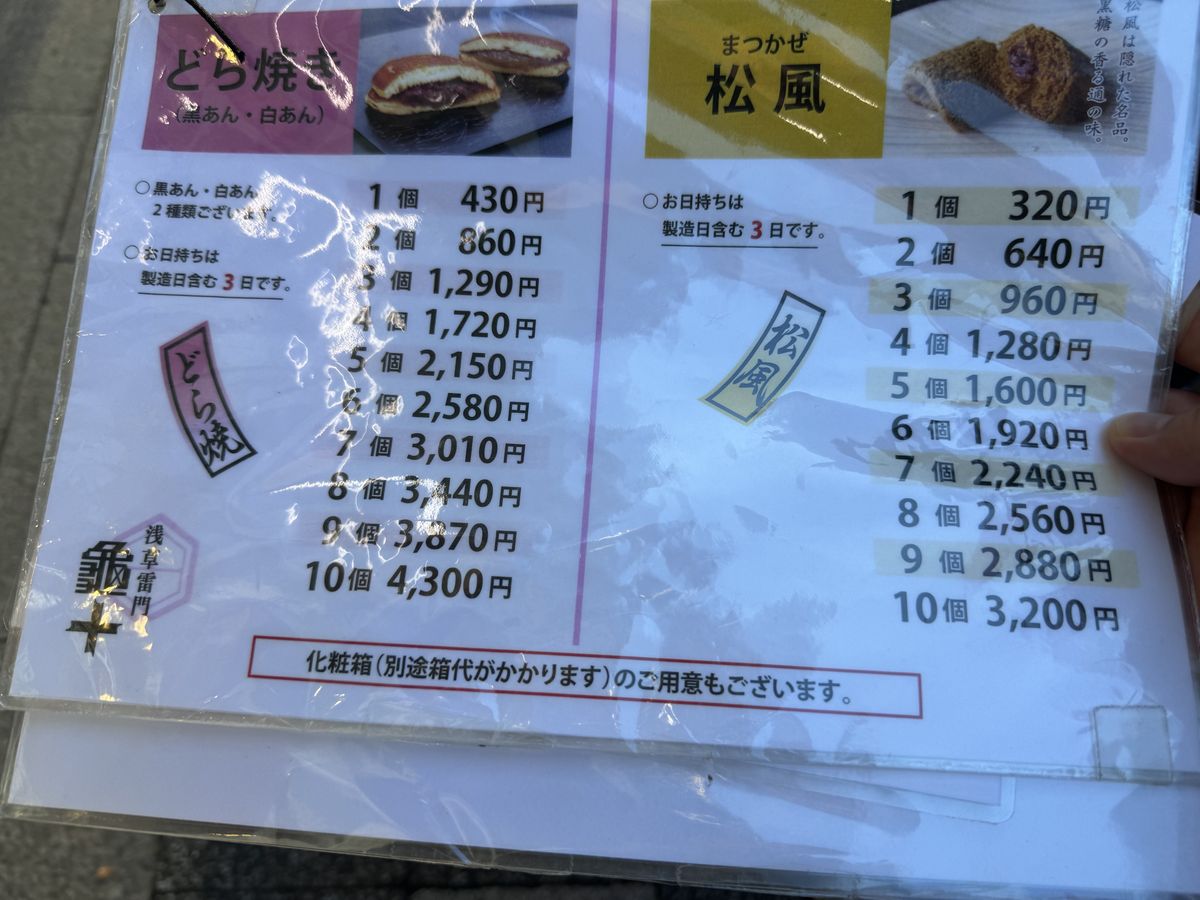
- Price: ¥430 apiece (black or white bean) — still the price as of July 2026. The board below is from my August 2024 visit, shortly after the last increase (¥390 → ¥430 in July 2024).
- The catch: lines are common and popular items sell out, often well before evening. I bought mine at 17:18 and the counter was still stocked that day, but don't build your schedule around it.
- If they're sold out: the food halls under major department stores sell very good dorayaki as a backup.
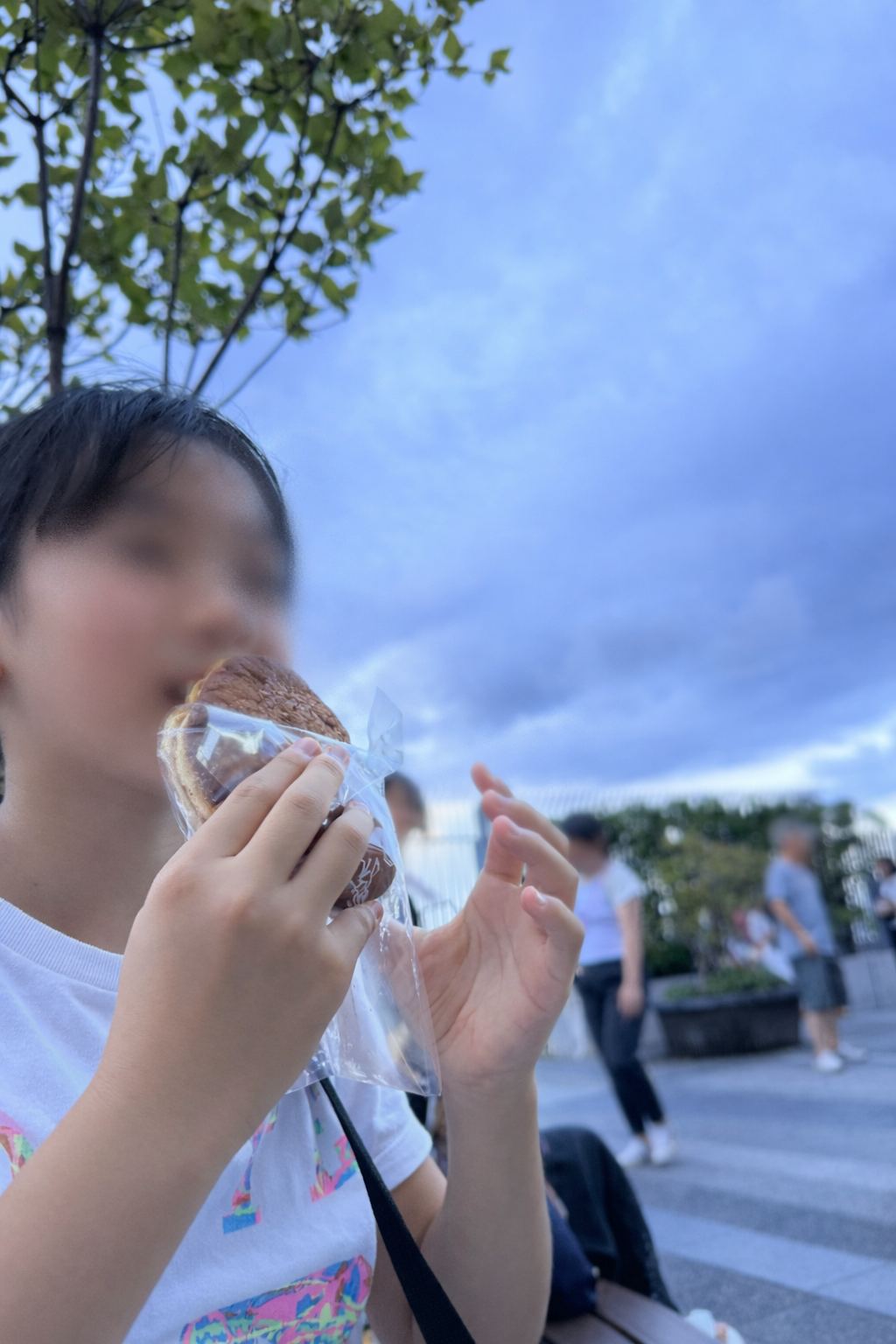
My evening ran: dorayaki at 17:18 → deck at 18:26 → back in Asakusa for a monjayaki dinner at 21:09. As a half-evening course from Asakusa, it flows naturally — the dorayaki is dessert-before-dinner, and nobody has to know.
The Plan, in Five Lines
- Look up the exact sunset time for your date (table above gets you close)
- Book the official online timed ticket for the entry slot that puts you at the 4F gates 30 minutes before sunset (add 10–15 on weekends)
- Aim to step onto the deck at, or just before, sunset time
- If you're early, wait in Solamachi — not in a line
- Stay through civil twilight: daylight, gradient, and night view are all on the same ticket
One connection covers everything this plan depends on: buying the timed ticket, showing the QR code, checking sunset times, Google Maps to the tower, train routes back to Asakusa, and uploading the photos you'll inevitably take. We've compared the main ways to get data in Japan — eSIM vs Pocket Wi‑Fi, with real prices.
Compare eSIM vs Pocket Wi‑Fi for Japan →This page contains affiliate links. We may earn a small commission at no extra cost to you.